500mg vs 1000mg vs 3000mg CBD Oil: Strength, Price per mg, and Who Needs What
Buy milligrams, not bottle theater. A 3000 mg oil is a concentrate. A 500 mg bottle is easier to dose small. Run the price-per-mg math.
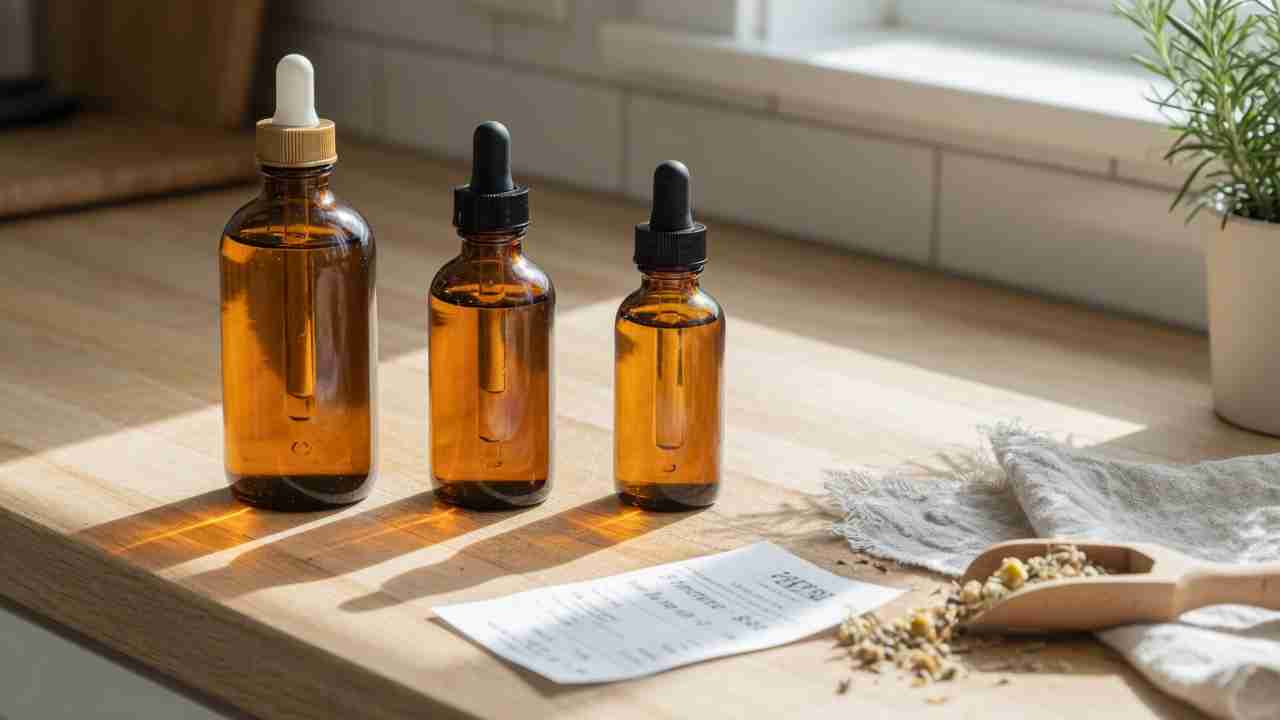
The number printed on a CBD bottle is not a personality type and it is not a medical grade. It is milligrams of cannabidiol dissolved in a carrier, usually 30 ml of oil. Ranking pages for 500mg vs 1000mg CBD oil still talk as if 3000 mg is “stronger medicine” and 500 mg is “for beginners,” then skip the only comparison that is honest: price per milligram, milligrams per milliliter, and whether you can actually measure a 10 mg serving with that dropper.
NCCIH’s consumer page is the right federal baseline for what hemp CBD is and is not: cannabis and cannabinoids (NCCIH). It will not tell you whether to buy the $40 500 mg bottle or the $90 3000 mg bottle. Arithmetic will.
What those ranking pages skip is dropper error, rancid-oil math, and the fact that a 3000 mg tincture is a concentrate. One sloppy squeeze is not “a drop.” It is a day’s milligrams for a new user.
What 500 mg, 1000 mg, and 3000 mg actually mean
Assume a standard 30 ml bottle, because that is what most U.S. tinctures still use. Divide total milligrams by 30 and you get concentration:
- 500 mg in 30 ml = about 16.7 mg per ml
- 1000 mg in 30 ml = about 33.3 mg per ml
- 3000 mg in 30 ml = 100 mg per ml
That last bottle is six times as concentrated as the first. It is the same plant molecule in less oil. Brands love the 3000 mg front label because it looks like a bargain and a flex. It is a dilution choice. A 15 ml bottle with 1500 mg is the same 100 mg/ml as a 30 ml 3000 mg oil. Read milligrams per milliliter, not the font size of the number.
If you want drop-level arithmetic after you pick a strength, use how many drops of CBD oil. A thin MCT oil is often near 20 drops per ml, but drop size moves with viscosity, hole size, and temperature. The 1 ml mark on a graduated dropper beats folklore. Full-spectrum at 3000 mg can also deliver more trace THC per serving than the same milliliters of a 500 mg full-spectrum oil; pick spectrum on purpose.
Side-by-side: 500 vs 1000 vs 3000 mg
| Question | 500 mg / 30 ml | 1000 mg / 30 ml | 3000 mg / 30 ml |
|---|---|---|---|
| mg per ml | 16.7 mg | 33.3 mg | 100 mg |
| Rough mg per drop (20 drops/ml) | 0.8 mg | 1.7 mg | 5 mg |
| Volume for a 10 mg serving | 0.6 ml | 0.3 ml | 0.1 ml |
| Volume for a 25 mg serving | 1.5 ml | 0.75 ml | 0.25 ml |
| Days at 10 mg/day (whole bottle) | 50 days | 100 days | 300 days |
| Dropper precision | Easiest small servings | Workable with marks | Easy to overshoot |
| Who it fits | New users, microdoses, shared household | Most daily routines | High milligram users, travel, cost-per-mg shoppers who already know their dose |
| Main failure mode | Worse price per mg; more bottles | None unique | Beginners take too much; bottle may go off before you finish it |
A 0.1 ml error on the 500 mg bottle is about 1.7 mg. The same 0.1 ml error on the 3000 mg bottle is 10 mg. That is why beginners often overshoot with 3000 mg: one extra drop is a lot. If your dropper is unmarked, do not buy the concentrate until you own a marked 1 ml pipette.
Price per milligram is the only fair comparison
Retail theater is a gold lid and a “3000 mg extra strength” banner. Adult shopping is price per milligram, then a matching certificate of analysis. Worked examples from real shelf math:
- $40 for 500 mg = $0.08 per mg
- $50 for 1000 mg = $0.05 per mg
- $90 for 3000 mg = $0.03 per mg — if the milligrams are authentic
That last “if” is the whole game. A fake 3000 mg oil at $90 is not a bargain. It is a $90 bottle of carrier with a loud label. The COA has to show milligrams per milliliter that match the claim: roughly 17 mg/ml, 33 mg/ml, or 100 mg/ml on a 30 ml bottle, within about 10%. Lot number on the bottle has to match the PDF. For the rest of the lab checklist, use how to choose quality CBD. For why cheap and expensive both fail without that PDF, use cheap vs expensive CBD.
Run 30-day cost at a dose you might actually take. At 25 mg/day you use 750 mg in a month. The $40 500 mg bottle cannot cover that month; you need two, so $80, still at $0.08/mg. The $90 3000 mg bottle covers four months of 25 mg days on paper. Only buy that stretch if you will store it cold, dark, and capped, and if you already tolerate 25 mg without guessing.
Ignore “servings per bottle” on the label when the suggested serving is 1 ml. A 1 ml serving of 3000 mg oil is 100 mg. That is not a beginner serving. It is a marketing serving designed to make the bottle look like it lasts 30 days at a heroic dose.
Why a 3000 mg bottle goes rancid at the same speed
High-strength bottles do not age slower. The cannabinoid is dissolved in a food oil. Light, heat, and oxygen still oxidize that oil. A 3000 mg / 30 ml tincture at 10 mg/day is 300 days of calendar time. You may not finish 30 ml if you use 10 mg/day. The last third can taste like crayons and pepper even if the first third was fine.
If your real dose is 10–15 mg, a 500 mg or 1000 mg bottle is the adult purchase even when price per milligram looks worse. You will finish it while the oil is still oil. If your real dose is 50–100 mg, the 3000 mg bottle starts to make sense: you empty it in one to two months, and the cheaper milligrams pay for themselves.
Store every strength the same way: amber glass, cap on, away from the stove and the car dashboard. Refrigeration is optional for MCT; it is more useful for hemp-seed carriers that go off faster. Do not “save” a half-used 3000 mg bottle for next year. Buy a size you will finish.
A practical pick list
- Write down the milligrams you already take, or the milligrams you plan to start with (many new users start near 10–25 mg). If you do not know, do not buy 3000 mg first.
- Divide bottle milligrams by milliliters. Confirm the COA’s mg/ml matches that number.
- Divide bottle price by total milligrams. That is your price per mg. Compare only among bottles with current, lot-matched labs.
- Check whether a 10 mg serving is at least 0.25 ml on that dropper. If it is a hairline of oil, you will overshoot. Buy a lower strength or a marked pipette.
- Estimate finish date. If it is past six months at your dose, drop a strength or buy a smaller bottle.
- If you travel and already know your dose, a higher-strength bottle means fewer containers through TSA. That is convenience, not potency magic.
- Refuse disease-cure language and “10,000 mg hemp oil” that is seed-oil mass. Strength theater and seed-oil tricks travel together.
Travel, TSA, and fewer bottles
A 30 ml tincture is a 1-ounce liquid. Three 500 mg bottles are three liquids. One 3000 mg bottle is one liquid with the same milligrams as six 500 mg bottles. If you already use a steady dose and you fly with hemp CBD, higher strength means fewer bottles in the quart bag. That is the only travel argument that is real. It is not a reason for a first-time buyer to start on 100 mg/ml oil. For the security-bin version of this problem, see can you fly with CBD.
Keep the original label and the COA screenshot on your phone. Security is looking at liquids, not at your milligram flex. Do not decant a 3000 mg oil into an unmarked vial and call it simpler.
You do not “graduate” from 500 to 3000
People treat bottle strength like gym plates. That is how they end up taking 40 mg when they meant 15 mg, then concluding CBD “makes them foggy.” Fog is often dose, leftover THC in a full-spectrum oil, or both. Stay on the milligrams that match the reason you bought the bottle. If 15 mg is enough, keep buying 500 mg or 1000 mg and ignore the 3000 mg display.
Switching up in concentration is useful when your measured dose is stable and you are tired of finishing a 500 mg bottle every three weeks. Switching down is useful when you keep overshooting. Neither switch is a clinical titration protocol. OTC hemp CBD still has no FDA daily value. Epidiolex milligram-per-kilogram math is for rare epilepsies under a prescriber, not for a wellness tincture.
COA mismatches that show up more on loud labels
The 3000 mg claim is the one most worth auditing because the incentive to exaggerate is highest. If the lab shows 62 mg/ml on a bottle sold as 100 mg/ml, you did not buy 3000 mg. You bought a 1860 mg bottle with 3000 mg packaging. Price per milligram just doubled, quietly. Delta-9 THC, solvents, metals, pesticides, and microbials still have to be on that PDF. A QR code that 404s is a refuse, at any strength.
FAQ
Is 3000 mg CBD oil stronger than 1000 mg?
It is more concentrated if both are 30 ml. A serving can still be 10 mg from either bottle. Strength of the bottle is not strength of your dose unless you swallow the same volume.
Should beginners start with 500 mg?
Usually yes, because 10–25 mg is easier to measure and you will finish the bottle. Start low, hold several days, then step 5–10 mg if you need to. Do not start by taking 1 ml of a 3000 mg oil.
Why is the 3000 mg bottle cheaper per milligram?
Extraction and testing have fixed costs. More milligrams in one SKU often land near $0.03/mg versus $0.08/mg on a small bottle — when the milligrams are real. Fake milligrams invert the math.
Can I mix a 3000 mg oil into a larger carrier to dilute it?
You can, if you do the arithmetic and relabel the new bottle. Most people should just buy 500 mg or 1000 mg instead of running a kitchen chemistry project.
Disclaimer: This article is for education only. It is not medical advice. CBD products are not FDA-approved to treat, cure, or prevent any disease. Talk to a clinician before you start or change hemp CBD, especially if you take other medicines or have liver disease.
